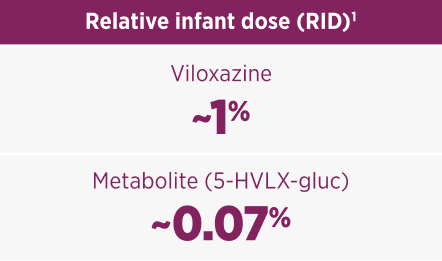
The transfer of Qelbree to breast milk is low1*

A woman cradles her baby in her arms
Actor portrayals.
A mother with her baby in her arms

Qelbree is the first and only ADHD treatment to meet the post-marketing requirement following the 2019 FDA guidance on clinical lactation studies1

A study of 15 healthy lactating women receiving Qelbree (600 mg for 3 days) showed1:

Relative infant dose (RID): approximately 1% for viloxazine (Qelbree) and approximately 0.07% for metabolite (5-HVLX-gluc).

*This study did not specifically evaluate the effects of Qelbree (viloxazine) on breastfed infants or milk production, nor are there additional data regarding these effects. The developmental and health benefits of breastfeeding should be considered along with the mother's clinical need for Qelbree and any potential adverse effects on the breastfed child from Qelbree or from the underlying maternal condition.1

Pregnancy registry

There is a pregnancy exposure registry that monitors pregnancy outcomes in women exposed to Qelbree during pregnancy. Healthcare providers are encouraged to register patients by calling the National Pregnancy Registry for Psychiatric Medications at 1-866-961-2388 or by visiting www.womensmentalhealth.org/preg.

Abbreviation: ADHD, attention-deficit/hyperactivity disorder.


Discover more:

Stay informed

Get Qelbree email updates, savings information, and links to helpful resources for you and your patients.

Sign up 

IMPORTANT SAFETY INFORMATION

INDICATION

Qelbree (viloxazine extended-release capsules) is indicated for the treatment of Attention-Deficit/Hyperactivity Disorder (ADHD) in adults and pediatric patients 6 years and older.

IMPORTANT SAFETY INFORMATION

WARNING: SUICIDAL THOUGHTS AND BEHAVIORS

In clinical studies, higher rates of suicidal thoughts and behaviors were reported in [read more] patients with ADHD treated with Qelbree than in patients treated with placebo. Closely monitor all Qelbree-treated patients for clinical worsening and for emergence of suicidal thoughts and behaviors.

In clinical studies, higher rates of suicidal thoughts and behaviors were reported in patients with ADHD treated with Qelbree than in patients treated with placebo. Closely monitor all [read more] Qelbree-treated patients for clinical worsening and for emergence of suicidal thoughts and behaviors.

CONTRAINDICATIONS

  • Concomitant administration of a monoamine oxidase inhibitor (MAOI), or dosing within 14 days after discontinuing an MAOI, because of an increased risk of hypertensive crisis
  • Concomitant administration of sensitive CYP1A2 substrates or CYP1A2 substrates with a narrow therapeutic range

WARNINGS & PRECAUTIONS

  • Suicidal thoughts and behaviors: Closely monitor all Qelbree-treated patients for clinical worsening and emergence of suicidal thoughts and behaviors, especially during the initial few months of drug therapy, and at times of dosage changes
  • Heart rate, blood pressure increases: Qelbree can cause an increase in diastolic blood pressure and heart rate. Assess these measures prior to starting therapy, following increases in dosage, and periodically during therapy
  • Activation of mania or hypomania: Noradrenergic drugs may induce a manic or mixed episode in patients with bipolar disorder. Prior to initiating treatment with Qelbree, screen patients to determine if they are at risk for bipolar disorder. Screening should include a detailed psychiatric history, including a personal or family history of suicide, bipolar disorder, and depression 
  • Somnolence and fatigue: Patients should not perform activities requiring mental alertness, such as operating a motor vehicle or hazardous machinery, due to potential somnolence (including sedation or lethargy) and fatigue, until they know how they will be affected by Qelbree 

ADVERSE REACTIONS

The most common adverse reactions (≥ 5% and at least twice the rate of placebo for any dose) in patients 6 to 17 years were somnolence, decreased appetite, fatigue, nausea, vomiting, insomnia, and irritability, and in adults, insomnia, headache, somnolence, fatigue, nausea, decreased appetite, dry mouth, and constipation. 

PREGNANCY

There is a pregnancy exposure registry that monitors pregnancy outcomes in women exposed to Qelbree during pregnancy. Healthcare providers are encouraged to register patients by calling the National Pregnancy Registry for Psychiatric Medications at 1-866-961-2388 or by visiting www.womensmentalhealth.org/preg. 

Please see full Prescribing Information, including Boxed Warning.

Reference:

1. Qelbree [package insert]. Rockville, MD: Supernus Pharmaceuticals, Inc.

IMPORTANT SAFETY INFORMATION

INDICATION

Qelbree (viloxazine extended-release capsules) is indicated for the treatment of Attention-Deficit/Hyperactivity Disorder (ADHD) in adults and pediatric patients 6 years and older.

IMPORTANT SAFETY INFORMATION

WARNING: SUICIDAL THOUGHTS AND BEHAVIORS

In clinical studies, higher rates of suicidal thoughts and behaviors were reported in [read more] patients with ADHD treated with Qelbree than in patients treated with placebo. Closely monitor all Qelbree-treated patients for clinical worsening and for emergence of suicidal thoughts and behaviors.

In clinical studies, higher rates of suicidal thoughts and behaviors were reported in patients with ADHD treated with Qelbree than in patients treated with placebo. Closely monitor all [read more] Qelbree-treated patients for clinical worsening and for emergence of suicidal thoughts and behaviors.

CONTRAINDICATIONS

  • Concomitant administration of a monoamine oxidase inhibitor (MAOI), or dosing within 14 days after discontinuing an MAOI, because of an increased risk of hypertensive crisis
  • Concomitant administration of sensitive CYP1A2 substrates or CYP1A2 substrates with a narrow therapeutic range

WARNINGS & PRECAUTIONS

  • Suicidal thoughts and behaviors: Closely monitor all Qelbree-treated patients for clinical worsening and emergence of suicidal thoughts and behaviors, especially during the initial few months of drug therapy, and at times of dosage changes
  • Heart rate, blood pressure increases: Qelbree can cause an increase in diastolic blood pressure and heart rate. Assess these measures prior to starting therapy, following increases in dosage, and periodically during therapy
  • Activation of mania or hypomania: Noradrenergic drugs may induce a manic or mixed episode in patients with bipolar disorder. Prior to initiating treatment with Qelbree, screen patients to determine if they are at risk for bipolar disorder. Screening should include a detailed psychiatric history, including a personal or family history of suicide, bipolar disorder, and depression 
  • Somnolence and fatigue: Patients should not perform activities requiring mental alertness, such as operating a motor vehicle or hazardous machinery, due to potential somnolence (including sedation or lethargy) and fatigue, until they know how they will be affected by Qelbree 

ADVERSE REACTIONS

The most common adverse reactions (≥ 5% and at least twice the rate of placebo for any dose) in patients 6 to 17 years were somnolence, decreased appetite, fatigue, nausea, vomiting, insomnia, and irritability, and in adults, insomnia, headache, somnolence, fatigue, nausea, decreased appetite, dry mouth, and constipation. 

PREGNANCY

There is a pregnancy exposure registry that monitors pregnancy outcomes in women exposed to Qelbree during pregnancy. Healthcare providers are encouraged to register patients by calling the National Pregnancy Registry for Psychiatric Medications at 1-866-961-2388 or by visiting www.womensmentalhealth.org/preg. 

Please see full Prescribing Information, including Boxed Warning.